



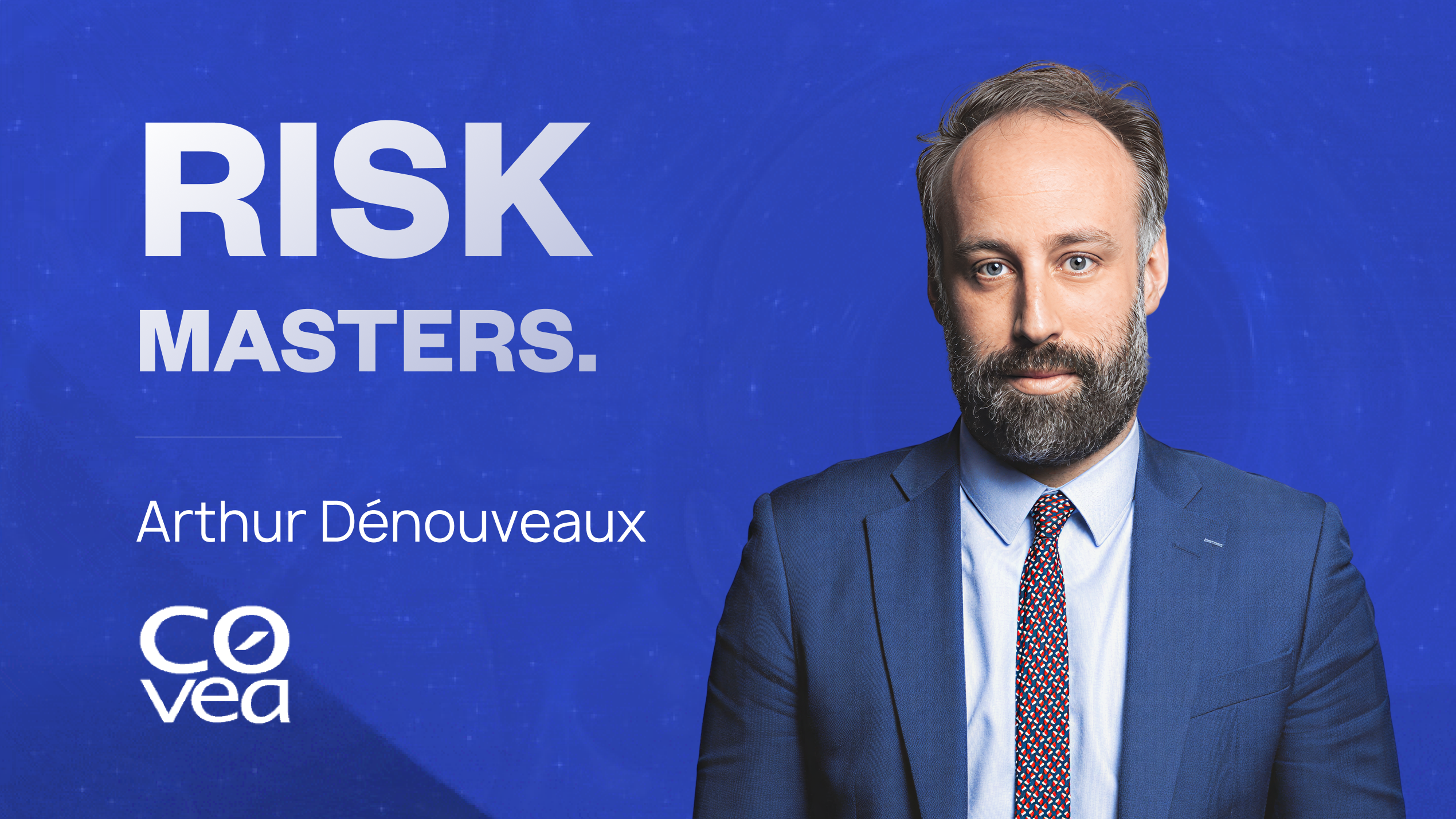
Arthur Dénouveaux came to insurance by a process of elimination. Yet the ex-proprietary trader ended up Chief Data Officer at one of France’s largest mutual insurance company. Whilst the industry celebrates rapid AI demonstrations, Arthur keeps faith in the unglamorous long-game: data access, governance, infrastructure. These are the true victories in a large enterprise: invisible from the outside but foundational.
Arthur, to get started, how did you end up in insurance? Will you be the first person to tell me that it was your childhood dream?
(Laughs) It was more a matter of elimination, honestly.
I was always drawn to mathematics. When I left school, I went into market finance. I started as a proprietary trader at Société Générale, then with Machina Capital, a fund we launched with some former SoGe colleagues. It was fascinating, but I began to feel this urge for change. These moments when you ask yourself the real questions: “What can I actually do?” In my case, my expertise consisted of optimising algorithms based on deep knowledge of a handful of markets and financial instruments.
From there, I had two paths, really. The first one was to have a bash at data science, but that was still a burgeoning field at the time. The second was to return to a large corporation, but which one? Who could dream of hiring an ex-prop trader? Banks perhaps, but they already had many profiles like me. So I turned to insurance.
At the end of the day, market finance and insurance respond to similar dynamics as trading is fundamentally about managing risk. I saw there were genuinely interesting things to build in that sector, so I took the leap. It was a deliberate move. My aim was to change from the financial market while putting my technical knowledge to use.
Loud and clear. So there you are: you’ve just decided that you’ll aim for a career in insurance. You leave the trading floors for a major mutualistic insurance company. Did that come with a shock?
Yes, but not the one you’re thinking of. I had prepared myself: I had read, I knew what to expect from insurance and from mutualistic companies.
The real shock was coming back to a big corporation.
I spent years at Société Générale, but a proprietary trading desk is an illusion of a large corporation. You operate in small, highly reactive commando teams with cutting-edge support infrastructure behind you. Decision-making capacity is immediate because it’s central to the business.
On the other had, a real big corporation is something else entirely. The number of people needed to validate something, the history you need to grasp before launching any new project, and so on. Matters arise at a fascinating scale and depth.
Do you have an anecdote that comes to mind?
I can think of many, but to pick one: my first day at MMA.
Picture this: we’re in the thick of COVID. The offices are empty. On the first day, I literally see no one. Day two, my first Executive Committee session.
That day, we were filming a happy new-year message addressed to more than 10,000 employees. It felt surreal to send a message to so many people I’d never met, and wasn’t likely to meet anytime soon.
Beyond the peculiar pandemic atmosphere, there was also the sheer scale that complicates everything. Getting a clear message across and conveying enthusiasm to thousands of people simultaneously isn’t something you pick up instinctively. It’s an actual science you can only learn through experience.
I can imagine. That brings me to a crucial matter: the team. You mentioned always being on the look out for people who “don’t think like you”. Can you expand on that?
The first rule is to know yourself relative to the role you’re taking on. When I arrived at Covéa Affinity, for example, I was a very junior insurance person. My first objective was to find someone with more grounding in those subjects than I had. I wanted to secure access to knowledge I’d eventually need.
Beyond that, I genuinely try to force myself to work with people who think differently from me. Obviously, it’s more comfortable to surround yourself with like-minded people. People who phrase things exactly as you would. But comfort is not only the easy choice, it’s a blinding one. I need people to have on my team people I struggle to understand, even when they’re explaining simple things. People who don’t use my vocabulary. Over the years, I realised I pick up a lot of signals and ideas from those semantic gaps.
And then there’s the matter of the ambiance. I’m convinced that a toxic work environment will inevitably leave its mark on business performance. Even if you have a good individual relationship with each of your direct reports, if they’re undercutting one another, you have to act. It’s one of the few reasons that justifies separating from a high performer. It doesn’t matter if we don’t have full information: if someone on the team is operating in sabotage mode, the long-term doesn’t hold.
Any other management best practices or routines you could share with us?
I try to keep things fairly informal. To put it simply, I prioritise brief, frequent contact. That translates to 30 minutes weekly with each direct report, supplemented by casual chats via messaging. They prepare a few topics to talk about, and I prepare mine. The more substantial issues are documented beforehand.
My priority is identifying as early as possible any friction between teams. That’s where my real value lies: going up a level when needed. For me, the manager is there to solve what can’t be solved lower in the hierarchy.
Is that a management culture specific to Covéa?
It’s fairly common, but it’s certainly pronounced within the group. The higher up you go, the less you’re expected to handle business-as-usual matters. The most senior people deal almost entirely with complicated issues. They move around, observe, act differently. They’re in constant motion to stay abreast of everything. They are always carrying out temperature checks. That way, they already have a pretty clear picture of the power map when problems arise. In an organisation as large as Covéa, the way you move and interact with all levels of the organisation is an actual skill.
Very interesting. I’d like to touch upon operational and strategic matters. You’re not an actuary, but you work daily alongside one of the most quantitatively advanced functions in insurance. How do data and actuarial science coexist at Covéa?
It’s interesting you’d ask, because we’ve made the deliberate choice at Covéa to separate the two functions.
Indeed, I’m not an actuary, but it’s a discipline I deeply respect. Actuaries have exceptional data maturity and a sophisticated approach to leveraging data. They also operate within a specific set of constraints, be they regulatory or ethical. It’s not our job in the data function to trespass on their territory.
The real mission of a data department is to aggregate and structure raw data to make it actionable and accessible to the right people. The actuarial engines, particularly on the retail side, are already pretty streamlined. Data teams deal more with matters related to the infrastructure, customer knowledge and journeys.
How would you define the added value of a CDO within a company today?
I like to think of my function as a ball joint.
We operate within a multi-brand group. We try not to interfere with each entity’s structure and governance. My role isn’t to overturn everything but to bring cohesion and solutions. That means having well-defined fields of expertise and responsibility. Nobody expects the business units to be data specialists, even if many understand and handle data well. Conversely, data teams aren’t there to explain the business to the experts. The real work is in understanding the need and translating it into solutions. It’s almost diplomatic.
It’s a fine balance to strike, which can only be achieved through listening. Sometimes you can add value through an idea convergence or a best practice you’ve spotted elsewhere, but we’re fundamentally at the entities’ service.
I also firmly believe a CDO has a pedagogical mission. We are there to help teams take the cultural leap. The last wave of technological advances is quite a game changer. I would compare it to the emergence of personal computers. We tend to forget, but that was a real turn we had to navigate. Back then, the “D” in CDO stood for digital. Today it means data. Tomorrow, who knows? We’re here to accompany the group through that permanent evolution.
Speaking of your title, you are Chief Data Officer, not Chief AI Officer. In an era that celebrates AI, it almost sounds like a statement. Why?
At Covéa, we have a branch dedicated to AI, Data, and Innovation. I cover the data function, with data science in my scope. The AI branch has its own structure but we all work together.
However, I genuinely believe data facilitates governance and business imperatives that can’t be reduced to AI. The heart of the matter is having quality data, data that’s accessible, data that someone can actually use. And at the core of it, oftentimes it is still a matter of business steering, financial reporting, and Solvency II.
Obviously, AI is sexier on paper. Ask an AI to create a PowerPoint on AI use cases and it will produce something incredible. On the other hand, you might be facing a colleague who can’t access the data on the CRM. It’s a different conversation. Yet that’s where the core challenge lies. I prefer those long, invisible projects; the ones that build the infrastructure on which AI can actually function effectively.
Covéa doesn’t project the image of a group chasing glitz. Would you agree?
Absolutely. Mutual culture is far more pragmatic and service-oriented. There’s an almost Protestant rigour about it. It’s about doing things properly. In that sense, it’s not a matter of pursuing glitz projects. The question lies in what to prioritze between immediate customer value and longer-term infrastructure projects. The rules are the same everywhere: you have finite capacity. What trade-offs do you make?
To borrow Mark Carney’s phrase on climate, it’s a “Tragedy of the Horizon.” Every data project, every infrastructure play, every industrialised AI initiative won’t bear fruit immediately but only over time. Meanwhile, you can rebuild bits of the customer journey fairly quickly with visible, concrete impact. The key is keeping balance between the two.
If you had to place three technological bets today, which would they be?
The first would unquestionably be agentic systems. It’s still somewhat speculative, but I see enormous potential in large corporations with complex and intertwined tech legacies. These technologies could theoretically reconcile all those systems without massive rip-and-replace efforts. They’d inject back some magic into what’s been gridlocked. In essence, it could lead to the end of technical debt.
My second bet is its corollary: AI for IT. We have chunks of code that are ancient, undocumented, but happen to be robust. The day you can deploy Claude Code against that, I think there’s real potential to produce something more efficient and easier to maintain. Think of it as heritage maintenance.
As for my third bet, it’d be AI for data science. Specifically, conversational interfaces that let you query data directly. I recently tested a tool embedded in one of our providers’ solutions. I was able to simply say : “I’m uploading this claims file. Run this analysis X for me?” It generated code in my language of choice and produced the results.
The business impact is enormous. If the data is clean, that would amount to giving every manager continuous access to information at scale. Differentiation stops being about “how do I extract information” and becomes “what clever insights can I draw from the data.”
You have a three-to-five-year strategic plan in a sector whose cycles are measured in decades. AI vendors, meanwhile, release a new version every six months. How do you live with that mismatch?
Honestly, the two horizons coexist without too much friction operationally. Every insurance group does strategic planning with longer or shorter time horizons. It works as long as you view data and AI simply as a means, a lever.
A five-year strategic plan can definitely be refreshed every six months. Our job as leaders is to build for the long term, not to lunge at the latest novelty.
The main issue I see lies in the temporality gap. Let me explain. Say you launch a service using a particular LLM. It’s virtually guaranteed that within two years, that model will be obsolete, replaced by a new one. So you had something reliable, robust, tested, but you end up having to rebuild it due to an update you never asked for.
Companies will soon face the challenge of sustaining their AI assets. That problem will stem largely from these new companies’ deep misunderstanding of how large-corporation cycles actually work. Sustenance is a far more complex problem to manage than inserting AI into a strategy.
Now that you’ve said that, what do you prefer: Make or Buy?
I’ll take the liberty of adding a third joker option: Make, Buy, and the Trojan Horse.
That’s the vendor you’ve worked with for years who eventually forces an AI solution on you. That’s probably the leading source of AI within the group right now.
On a more serious note, you’re forced to decide case by case. Building a solution in-house can have real merits from an acculturation and training perspective. You’re not a good buyer if you haven’t dug into the technology yourself and have no idea what development would have cost.
As for Buying, I resort to it more when you’re talking about a standardized IT process or when the solution centralises experience drawn from the entire market.
Arthur, thank you for all these insights. I’d like to close with the traditional send-off question: what advice would you give to a young person graduating today?
Three pieces of advice, in that order.
“Push your studies to their limits, and do a PhD.” We’re entering a world of specialists. Everything that isn’t expertise is being commoditised at breakneck speed. Beyond soft skills, which are obviously crucial, the real value-add is being exceptionally good at something. My sense is that AI is killing the generalist, and that will favour deep expertise.
Second: “Try, try, try.”
And finally: “Alternate between large corporations and smaller structures.” Both have their strengths and equal weaknesses, just different ones. The real shortcoming is not understanding the other side. I can see it clearly on a daily-basis: there’s still far too much mutual incomprehension about how each operates. Small enterprises and large corporations will only thrive together if enough people have experienced both environments.
Arthur Dénouveaux is Chief Data Officer at Covéa. A graduate of École Polytechnique and holder of a Master’s in Finance from Dauphine-ENSAE, he began his career in market finance—first as a proprietary trader at Société Générale, then as co-founder of investment fund Machina Capital. He has been with Covéa for five and a half years, successively leading innovation at MMA, running Covéa Affinity, and holding a cross-functional chief of staff role that included steering group transformation and communications.
