![[4]](https://www.continuity-tech.ai/wp-content/uploads/fav-192x192-continuity-150x150.png)
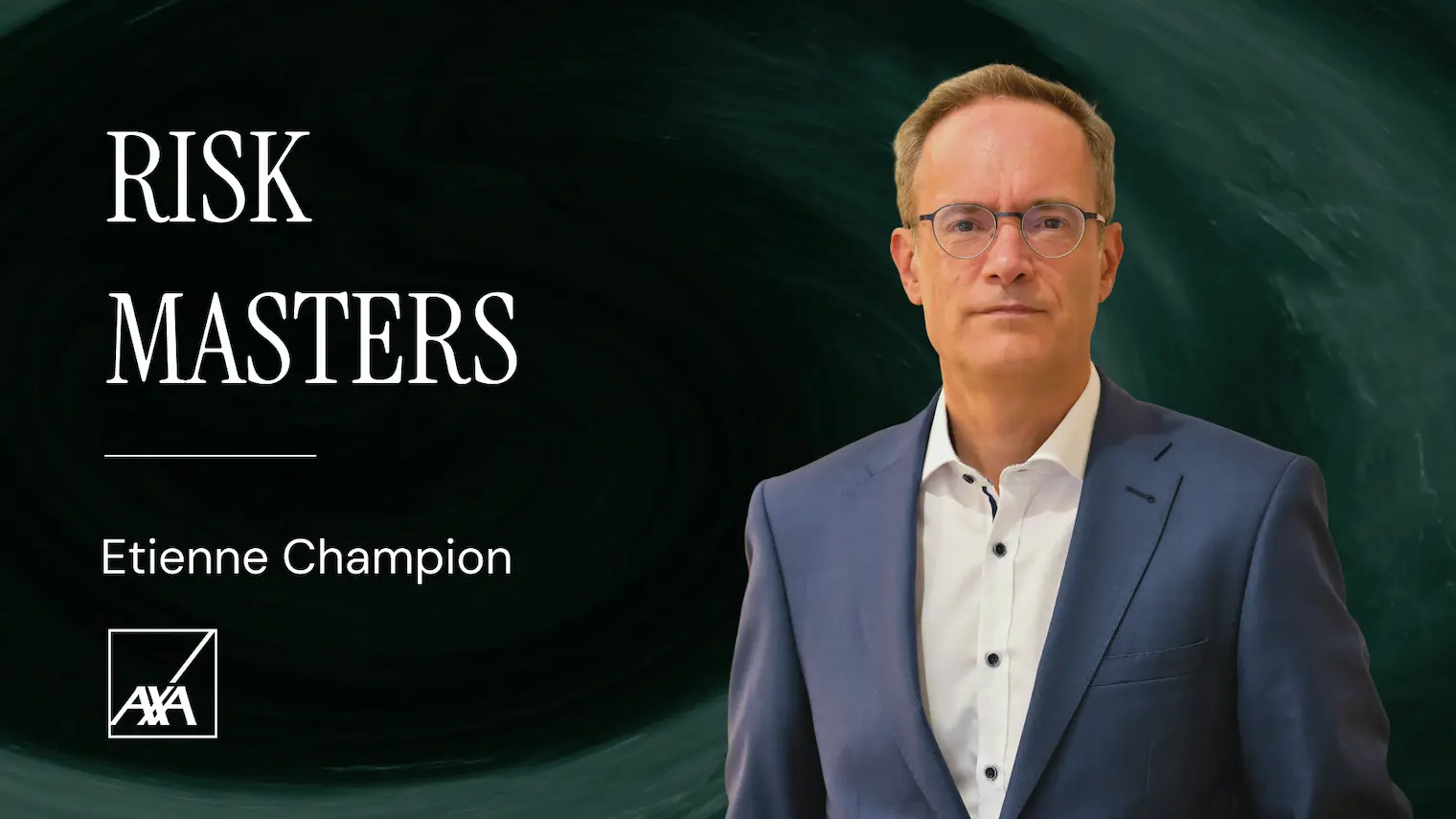
From bacteria-led soil decontamination in Arizona and France, to the head of AXA GIE’s P&C Commercial Lines underwriting division: twenty-five years within the same group, five countries, and a technical background he has never strayed from.
Here is my discussion with an engineer who has built his career on a rather counter-intuitive conviction for a scientist: precision does not exist.
Etienne, the question I like to ask to start with, because no one ever answers it in quite the same way: how did you end up in insurance?
Out of conviction.
My original ambition was to become an environmental engineer. I applied to the École des Mines de Paris because, at the time, it was one of only two generalist engineering schools offering a biotechnology programme.
I chose that as my specialism, and I worked as a soil and groundwater remediator using bacteria. I did that for five years; two in the United States and three in France. My first life.
Using bacteria for soil remediation in the 1990s was quite pioneering, I imagine?
Absolutely.
Back then, biotechnologists formed a tiny but extremely close-knit community. I was lucky enough to go to Arizona, which had developed cutting-edge technology that was unrivalled anywhere else in the world at the time. Generally speaking, you could say that the US was well ahead of the game. The very specialised techniques we used back then have since become more widespread.
To give you a more concrete idea, I was decontaminating chlorinated solvents. As a bit of trivia, the fact that Phoenix exists in the middle of the desert is down to the semiconductor industry. Without going into too much detail, etching silicon requires large quantities of solvents. But back then, used solvents weren’t recycled as they are today… Hence the pollution.
When and how did you switch to insurance?
It happened when I returned to France, which came as a real shock.
I’d come from a highly sophisticated sector, and I discovered a country that lagged far behind the United States when it came to cleaning up soil and groundwater. Bioremediation was virtually non-existent here. My job mainly involved filling lorries with soil and sending them to landfill. But landfill isn’t remediation: it’s simply a transfer of pollution. Bioremediation, on the other hand, actually transforms organic molecules into CO₂ and H₂O.
In short, I was no longer at peace with it, and returning to the United States was not an option. So I asked myself: which sector might well want this technical expertise?
The answer was right in front of me. On construction sites, remediation was carried out under the supervision of insurance experts, who governed the market through the tenders they organised on behalf of insurers. During a conversation with one of them, I realised that insurance companies were looking for people who knew the field; professionals with sufficient technical expertise to set premiums, review policies, and, above all, speak to manufacturers in practical terms.
At the time, third-party liability was almost entirely underwritten by lawyers. That said, there was someone at AXA who was visionary enough to bet that risk managers would soon want to build their covers with engineers capable of understanding their processes.
I was hired in October 2000 as a third-party liability underwriter, responsible for industrial clients in the environmental sector: drinking water, landfill sites, and waste treatment.
At Continuity, we believe that underwriting is an instinct that is developed over time and through experience. This makes it all the more interesting but not easy to grasp when you’re just starting out. How did you get up to speed?
The old-fashioned way; by sitting alongside experts and working through policies, the more complex the better.
I was lucky enough to join one of the best liability teams in the industrial risks market, featuring many big names. They brought me up to speed very quickly, particularly by entrusting me with the programmes of major CAC 40 clients, which threw me in at the deep end straight away.
Regarding your point, there’s a jargon that you pick up relatively quickly and an intuition that is indeed forged over time. In any case, being rather curious by nature, I immersed myself in the subject and soaked it all up.
On the other hand, as you were saying, I really was starting from scratch. It’s hard to believe now, but during my first interview, I asked the man who was to become my line manager: “But what does an underwriter actually do?” (Laughs)
And as an engineer, did you experience a culture shock when you first delved into third-party liability?
That’s quite an understatement!
I’ll start by saying that third-party liability is intellectually fascinating. It involves extremely subtle legal mechanisms, a whole science behind the structuring of policies and the development of reserves, and so on. But the characterisation of risk at the underwriting stage relies on far fewer quantifiable criteria than in other lines of business.
As an engineer, my instinct was to look for frameworks, figures and precision. Instead, I was confronted with this line of business, with its long time horizons, its severity, low frequency and, above all, its highly complex quantification.
This is all the more true for industrial risks. Property lines — and first-party lines in general — are awash with figures at the point of underwriting: risk factors, prevention criteria, natural catastrophe models from various providers… but sometimes those figures create a false impression of certainty.
That’s probably the main thing I’ve learnt from my liability years: the complexity of the risks covered, and the speed at which they evolve, demand real caution towards any indicator that gives you the feeling of having found the truth. The reality is that models are only as good as the data we feed into them.
My engineering background had led me to seek precision. Third-party liability taught me that it doesn’t quite exist.
I understand. That brings me to the next topic I wanted to discuss with you: artificial intelligence. Considering the pace at which it is gaining ground, what will remain of the underwriter’s role? What will we never entrust to machines?
That’s the burning question we’re currently grappling with, as this revolution sweeps over us.
I believe a whole range of data-preparation tasks is set to disappear. In fact, this is already largely the case. AI carries them out very well and formats data remarkably well.
However, that’s not where I expect it to make its mark; rather, it’s in analysis and interpretation. By this I mean in-depth understanding, and the inferences we can draw from a vast knowledge base or dataset to guide decision-making.
And the pace of progress is dizzying. An experienced user of LLMs recently told me that his tools had just successfully carried out analyses that they were still unable to perform twelve months earlier.
However, I believe that validation and governance will inevitably remain human tasks.
Pierre du Rostu, CEO of AXA Digital Commercial Platform, recently shared an eloquent simulation: five worlds left to the mercy of models, without the slightest human supervision. The results speak for themselves: two worlds collapsed within a few days, only two remained stable, and the last one went off the rails. It is striking to note in this experiment that the AI models ended up corrupting one another, each pushing the other to circumvent the rules that had been set for them.
This is precisely why we must keep a human hand on the underwriting decision.
AI will fundamentally transform the business. Whatever happens, we will need to be able to adapt.
Have you already rolled out AI within your remit?
Absolutely. The Group and the AXA entities are investing heavily in this area and will continue to do so. For my part, it was really important to me that my teams took ownership of the subject; that the initiative came from them.
So I tried to integrate these practices in the simplest and most organic way possible.
I got us a few licences for an internal tool — secure but a little more powerful than the standard version — and asked the whole team to complete the training, myself included.
From then on, I gave them just one instruction: play around with it. Use this tool whenever you think a process could be simplified. No specific targets, no predetermined deliverables, no set percentage of time allocated.
As a result, and I’m very proud of the team, a use case developed precisely during this free time was presented at the Group’s AI conference and to several Group entities that intend to use it. It’s an eight-page prompt that significantly speeds up the processing of referrals.
The strength of this new generation of tools is that they remove the barriers to creativity and significantly reduce the costs associated with large-scale project management. Anyone can iterate on use cases and validate requirements. From there, specialist teams can take over to stabilise, industrialise and scale up the solution, but this crowdsourcing approach can truly transform our business lines from within.
Very inspiring! I’d now like to go back over your career path, if you don’t mind. What strikes me is its diversity, in terms of products, roles and geographies. Looking back, what served you the most?
First of all, we’ve become unbeatable when it comes to moving house. We must be on our fifteenth move by now. (Laughs)
More seriously, moving around so much helps you become more hybrid in your mindset, your culture and your instincts. You inevitably gain some perspective. A consequence of that is that you also distance yourself a little from your own culture. I’ll always be French, of course, but you gather other perspectives along the way.
This comes from being confronted with situations you’d never have experienced had you stayed at home. It puts you to the test in the real world.
To use a technological analogy, I like to think we’re all equipped with a data bank. When you first go abroad, you arrive with your preconceptions, your reflexes, your ways of interpreting things. Yet that’s precisely what you need to be wary of. As your experiences accumulate, this database grows richer; you gather information that allows you to gain a more nuanced perspective. You end up more open and observant, and less reactive. This allows you to judge less hastily, to let things settle, and ultimately to make better decisions.
One thing is certain: I’m not the same manager I was before I left.
In which environment did you feel most put to the test?
In Asia, clearly, or else in Germany, because the cultural divide isn’t measured by the number of kilometres separating you from Paris.
In Asia, what taught me the most was the approach to debate. I’m convinced that the quality of discussions within a team determines success: you need free speech, psychological safety, and a leader who doesn’t have all the answers.
However, over there, contradicting your superior is far more delicate. There are ways of doing it, but they can sometimes be difficult for a Westerner to pick up on, at least at first.
I remember a colleague who had just expressed, in his own way, a disagreement. Failing to pick up on the nuance, I understood exactly the opposite: “Everyone agrees.”
In the end, I found myself making the decisions alone, with the level of discussion falling well short of what I’d expected. To put it another way, the less open the discussion, the less collective — and the less sound — the outcome.
So I learnt to gather opinions differently, largely from one-to-one conversations. It was there, in those more intimate chats, that I learnt to decipher what was really being said.
And when it comes to the fundamentals of management, did you have to adapt much from one country to another?
No, I consider myself relatively traditional in that respect.
My modus operandi consists of team meetings, one-to-ones, and informal discussions. I’m thinking of the sacrosanct coffee machine, which we missed so much during the Covid pandemic, or meals with colleagues that get people talking and sharing ideas. In short, all these are opportunities that foster connections, meaning and information.
However, if I had to pinpoint one thing that sets me apart, I think it would be the importance I attach to communication, or over-communication even.
We tend to think we’ve got a message across when, in reality, only a third of those you’re speaking to have actually taken it on board. The trap is to think, “Nobody’s reacted, so everyone must agree.” I can assure you that this is not the case.
Driving change is, above all, about communicating so that everyone climbs aboard, asks their questions, and sometimes amends the change itself, because they will have seen what I didn’t.
In practical terms, what does over-communicating involve? Written or spoken communication?
Mainly verbal. Written communication is necessary to record decisions, but in my view, verbal communication is a more powerful driver of change than the written word.
You have to tirelessly repeat the messages so that they sink in and become a reality. The ultimate goal is for your teams to echo your words when you’re not in the room.
To achieve this, you naturally need to collate the information, clarify it, and then move on to something else. Then, the following week, give a reminder, followed by another the week after that, and so on. This helps to ensure that everyone has understood correctly and that the changes are being implemented. Our organisations are complex. If the carriages come uncoupled, you lose your team and, with it, your ability to deliver.
One approach I like is to summarise projects in mottos or catchphrases.
Do you have an example you could share?
The most telling example dates back to my time at AXA XL. The industrial risk insurance market at the time (2020–2021) experienced a strong and rapid recovery, made necessary by very poor past results. By 2023, it became apparent that this hard market phase was set to ease off, level off and then gradually adjust over the coming years.
At that point, my role was to initiate this shift for hundreds of underwriters who had experienced major changes to their processes and portfolios over the previous two or three years. The key was maintaining the teams’ level of commitment and discipline.
We therefore coined a motto: Chapter 2. These two words illustrated the need not only to collectively turn the page but also to fall into a new order of march. It may seem trivial, but this simple phrase encapsulated the desired change and became second nature to the team; a bearing we came back to on every file: “What does it mean, in practice, to be in Chapter 2?”
It got us moving again.
What I’m gathering from what you’re saying is that a crisis is almost easier to navigate than the return to calm?
Absolutely!
Crises are electrifying. They come with their load of energy. They almost naturally lead people to coordinate and rise to the challenge. Admittedly, the pressure is high, but there’s little inertia; taken to the extreme, you have (almost) nothing to do, especially when working with highly skilled teams. (Laughs)
Conversely, I find “non-crisis” phases more difficult to navigate. They require more support.
It’s also very interesting to see the differences in how these transitions are managed. Some teams excel under pressure, but experience a real drop in motivation once things calm down.
In short, these aren’t restful phases to go through, but they’re certainly fascinating from a human perspective. My approach in these situations, once again, is to over-communicate.
There’s a great deal of empathy in what you say. You talk about purpose, commitment… Are these important aspects for you in your work?
For me, but for everyone, I think.
I have a very simple belief: nobody gets up in the morning hoping to be of no use.
We get up to achieve something that has meaning.
It seems basic, yet in our roles, we may be asked to work on topics whose significance isn’t immediately obvious to the teams.
In such cases, it’s important to take all the time needed to clarify and define the mission, so as to give it a clear purpose again and place it within a broader, deeper context. What I’ve noticed is that everyone’s commitment is at its highest when they truly understand the purpose of the mission.
It’s an investment that pays back a thousandfold.
Etienne, thank you for all these insights. One final question: what advice would you give to the Etienne of thirty years ago, fresh out of school — or to a young graduate today?
Three things.
Stay curious. Hold on to the curiosity of the rookie you once were, and keep it throughout your life: it’s an inexhaustible driving force.
Next, learn to express yourself. The ability to communicate has never been more crucial, whether addressing a room or speaking to a screen. Cultivate this art, to convey, receive and inspire.
Finally, learn to collaborate. In a large organisation, it’s essential to know how to align yourself and contribute to projects — sometimes complex ones — in which many people are involved.
This wasn’t a key educational focus for my generation, in France at least. Some cultures base a large part of their education on this: not just the content, but the way it is shared. I hope we can bridge this gap, as it is the key to building tomorrow.
—
A civil engineer from the École des Mines de Paris and holder of a Master’s degree in environmental sciences from Arizona State University, Etienne Champion began his career in soil bioremediation, first in the United States and then in France. He joined AXA in 2000 as a third-party liability underwriter specialising in industrial risks. Over the course of twenty-five years and various executive roles, his career has taken him from Paris to Cologne, Brussels, Singapore and Dublin — from AXA Corporate Solutions to AXA XL. Since November 2023, he has been Group Chief Underwriting Officer for P&C Commercial Lines at AXA.