![[4]](https://www.continuity-tech.ai/wp-content/uploads/fav-192x192-continuity-150x150.png)
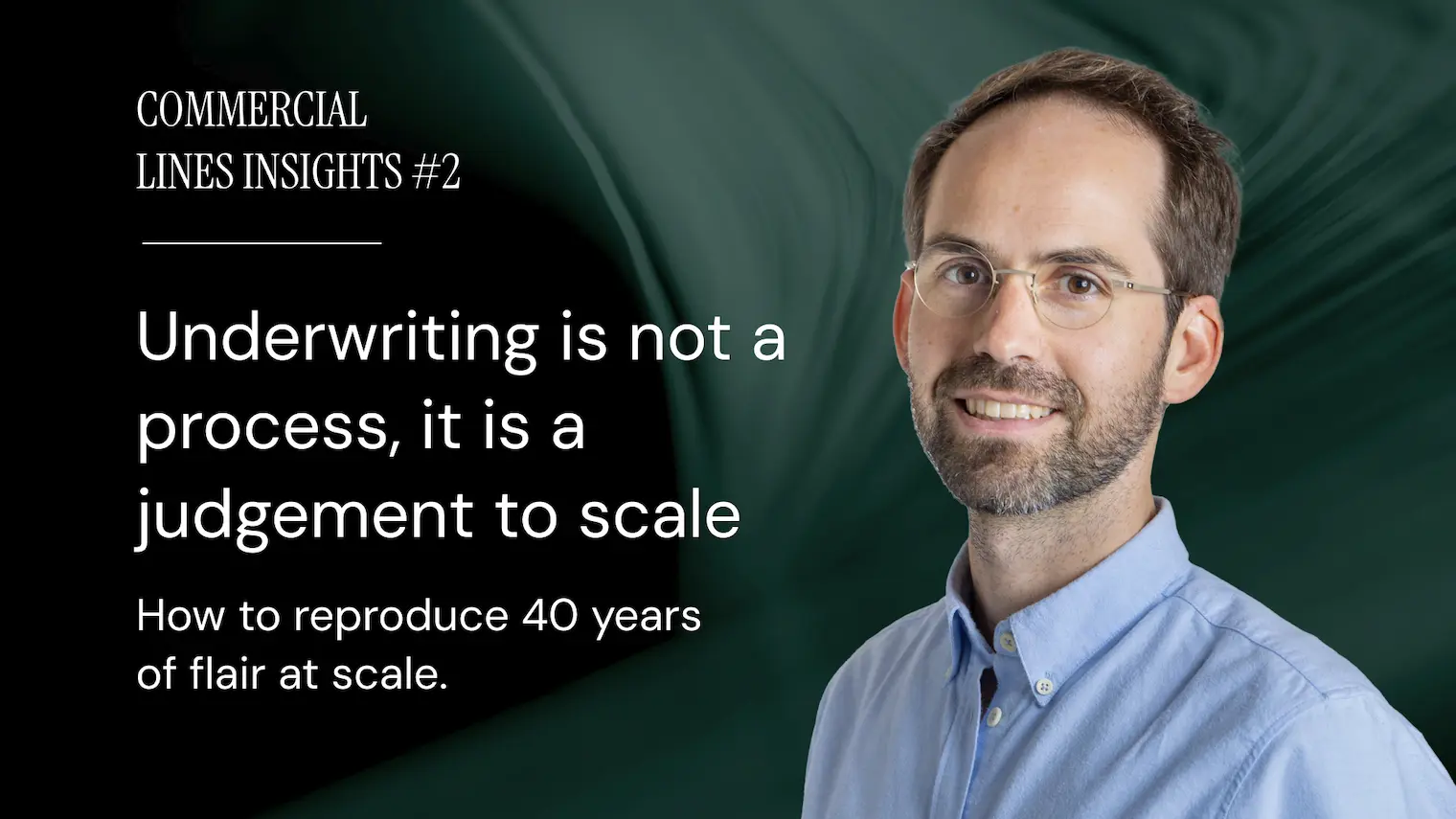
The digitisation of expertise, or how to recreate 40 years of intuition at scale
For a long time, digitising underwriting meant organising operations more effectively, segmenting variables, optimising administrative tasks and streamlining systems.
We multiplied tools. So much so that 60% of underwriters now juggle seven or more systems daily.
This tangle of solutions has generated fatigue and noise, pulling attention away from what matters: risk analysis. In fact, only 34% believe their current tools effectively align decisions with portfolio strategy.
We have numbed and obstructed judgement, when the real challenge is precisely to create an environment in which human intuition can flourish.
This is especially true in Commercial Lines, where expertise remains the primary differentiator. And that expertise doesn’t need replacing. It needs scaling.
You can afford getting the premium wrong, not the risk.
The corporate market leaves no room for error on risk.
A premium error can sometimes be corrected. A risk error stays in the book for years. In a market with thin margins and fierce competition, pressure only builds.
You’re expected to be more responsive AND more technically rigorous. But how do you make the right call without a complete file? How do you take a sound decision when you can’t see what you’re carrying?
This is a widespread problem. 73% of underwriters report struggling with portfolio visibility.
At the same time, the talent shortage is biting. Senior experts are becoming scarce. Juniors must make complex decisions earlier, with less experience and less time. Knowledge transmits more slowly than it disappears.
Getting the risk right means complete information and expertise accessible at every moment, throughout the entire life of the risk.
The goal, then, is not to replace the underwriter. It is to scale their reach.
In an efficient market, expertise becomes the edge
If AI tools become more accessible, the advantage won’t come from the model alone. It will come from the quality of judgement the system around the model enables.
An insurer who selects risks better can return to core markets, more aligned with their appetite, better controlled. They can grow without diluting their portfolio.
Conversely, an insurer who gets their model or their use of AI wrong may face adverse selection. They receive the risks others decline. They arrive too late on important decisions and progressively lose control of their book.
The difference, then, won’t be speed of execution but rather the depth of judgement embedded in decisions.
In a market where AI is spreading, whoever best integrates human expertise into their system gains the advantage.
Putting an expert behind every policy
An underwriter’s instinct can seem almost unattainable.
It’s a combination of risk knowledge, claims memory, understanding of business operations, reading subtle signals, knowing brokers, the ability to challenge information, grasping exceptions, a sense of prevention, commercial intuition, and the capacity to negotiate without losing grip on the risk.
This expertise is concentrated in a few heads today. It is often tacit and slow to impart before being entirely lost when seniors leave.
The new wave of technology supporting this expertise is about capturing part of that reasoning to assist the underwriter at every key moment in the life of the risk: qualification, decision, renewal, prevention, negotiation, even escalation.
Obviously, many aspects won’t be reproducible. But some decision-enabling elements already are: data synthesis, weak signal detection, comparison with similar cases, guideline application, and prioritisation of files to review.
The emphasis must be on decision preparation, decision traceability, and the enforcement of underwriting precedents.
The rest is and will remain human: interpretation, context, broker relationships, negotiation, accountability.
AI is no longer a threat. It’s an opportunity to seize.
In 2024, 74% of underwriters feared being replaced by AI. By 2025, that figure had fallen to 48%.
The debate is no longer: will AI replace the underwriter? It has become: how can we use AI to make expertise available earlier, more often, and across more decisions?
Yet the tools deployed to date focus primarily on process and data management. Tomorrow’s challenge lies elsewhere.
Our conviction at Continuity is that AI must amplify underwriters’ judgement and make it more broadly available.
It must help teams focus their time on the risks that matter. It must enable the shift from point-in-time underwriting to continuous monitoring. It must give every decision the full reach of the expertise available across the organisation.
That is what we call Risk Intelligence.
The future of underwriting is not total automation. It is augmented expertise.
Benoît Pastorelli
CEO, Continuity