



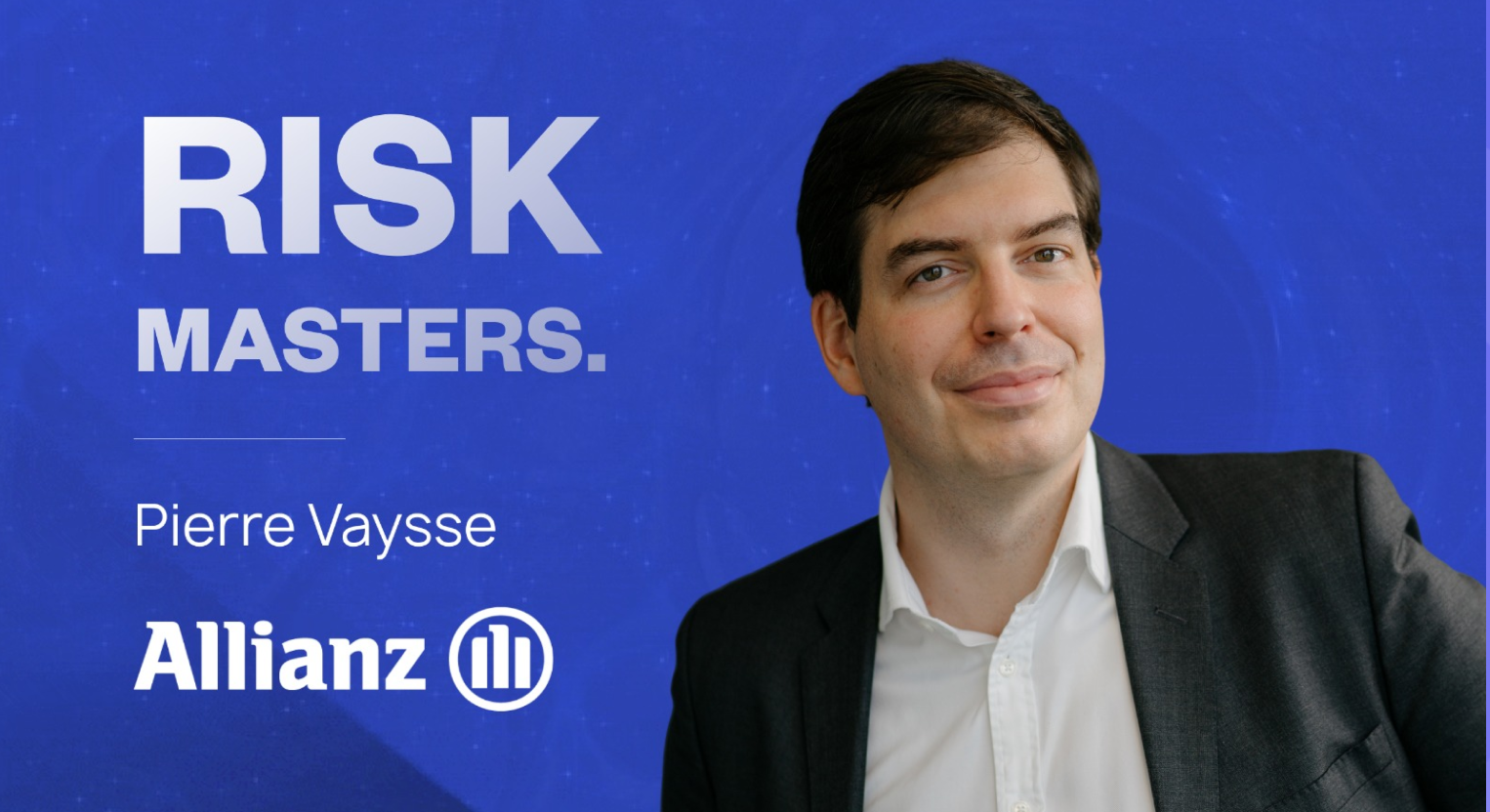
Some careers read like proofs. Pierre Vaysse’s is one of them: fifteen years modelling risk in every form — finance, actuarial, underwriting, health and protection — before becoming CFO of one of France’s leading insurers, still feeling like he hasn’t covered the ground.
Here is a conversation with a numbers man who understood early on that the real variable inside any organisation are its people.
Pierre, how does one end up in insurance? Few have referred to it to as a childhood dream
Let’s say I followed a strong conviction of mine : I didn’t want to do physics or chemistry. (Laughs)
On a more serious note, at the root of it all comes a strong taste for mathematics. When I arrived at Polytechnique, I started taking an interest in maths applied to economics, and I really took to it.
From there, I went on to study statistical modelling and probabilistic representations of the world. That opened the door to risk theory, and thus to insurance.
So to answer your question, I wasn’t dreaming of insurance at the age of six, but by the time I was studying I knew this was the sector I was heading for.
You’re stepping in with a fairly atypical background for a CFO. How will that shape your role, do you think?
It’s hardly exotic, but it’s true that my path has a strong technical, business-side teint, whereas many CFOs come from pure finance.
My aim is to draw on that technical grounding to stay genuinely close to the business and to bring meaningful challenges to the table.
I consider myself lucky to have spent a lot of time on the operational side — actuarial, pricing, underwriting, investments, health and protection. It helps me dive deeper into the matter at hand.
I say this in all humility however, because I’m well aware I still have a lot to learn. I’ve never run a network of tied agents, for instance, or led a large claims or customer service operations.
I still have a lot of depth to explore but that’s what makes it interesting.
Do you still get your hands dirty?
Taking on a broader scope inevitably pulls you away from the day-to-day. That said, I make a real effort to stay close to the ground — especially the modeling side.
I want to understand who’s carrying the risk, how it’s being modeled, what the smart transfer mechanisms look like, and how you measure them.
I’m nowhere near as deep in the code as I used to be, but that’s something I genuinely loved — building something, running the model, and immediately digging into the results.
I still dabble here and there to keep my edge, but I’m also finding real satisfaction in the dimensions that my new roles provide.
Pierre, we’ve known each other for a few years, so I’ll be a little provocative: what’s served you more — being an analytical beast, or being someone people actually want to work with?
That’s elegantly put.
Honestly, I think my biggest asset is curiosity. Intellectual curiosity, of course, but above all curiosity about people.
I have a genuine interest in what others are doing. I’m convinced that’s what’s carried me furthest throughout my career.
Curiosity is what drives you forward, but it’s also what makes people want to work with you. That kind of cohesion is invaluable — for the organization and for everyone involved.
It’s one of the messages I try to convey to my teams: go talk to the people on the ground. Go for a coffee to hear the business side of the story. Open your eyes.
Insurance is so rich and so complex that you simply can’t move forward if you don’t understand what the person next to you is actually doing.
You’ve changed roles many times within Allianz. How do you go about getting up to speed in a new role or field of expertise?
My first source of learning is always the team. I try to spend as much time as possible listening, asking questions, and challenging. At the end of the day, they’re the ones who actually know.
Over the years I’ve also worked with coaches, and I’ve had a wide array of mentors. Most of the time, they materialised as informal arrangements with former managers, some of whom had already left the company. However, at the end of day, the professional dimension fades and it becomes something closer to friendship.
But as I said, nothing replaces time spent with people in the field. That’s where you truly understand a business.
Across all those roles and teams, were there ever shocks — or at least genuine surprises?
Absolutely. The biggest shock for me was the move from investments into technical functions. You go from a very Cartesian, rational world — markets, models, numbers — into something completely different. On the other hand, the technical side quickly shows you that the model isn’t everything. It’s also about the conversations, the competition, and negotiation.
Add to that the discrepancies that are inherent to any company. Indeed, cultures can be strikingly different depending on roles or lines of business. P&C and Health/Protection, for instance, are wildly different. Operations shape people, priorities, and the culture around them.
Over thirteen years I’ve had to recalibrate my approach several times, but it’s important to hold onto certain pillars so you don’t lose yourself in the process. Here’s another piece of advice I give my teams: move around. Keep exposing yourself to new areas of expertise and new ways of working.
Someone running a scope like yours must be pulled in every direction. What habits do you keep to avoid getting overwhelmed?
You never have quite enough discipline, I think. My calendar is honestly too full, but that stems for the bias we just mentioned.
I try to spend as much time as possible with people. I’ve always worked that way and will keep doing so. Of course, it’s time-consuming, but it’s also the richest and most effective way to operate.
My week is built around weekly individual meetings, about 45 minutes each, with my manager, with all my direct collaborators. And I stick to them. They’re fairly informal, although I usually ask people to come in with a list of topics we can work through together. The beauty of doing it every week is that nothing ever stays unresolved for more than seven days.
The downside is that I always feel like I lack time for deeper thinking on the bigger topics. Fortunately, I have a brilliant assistant who helps a lot. Alternatively, I end up doing that thinking in the evenings or on weekends. That doesn’t bother me, because these are subjects I actually care about.
You’ve been on the Executive Committee since mid-2023. How did you feel the first time round and what’s shifted since?
I remember it very precisely as it was also my birthday, which helps. (Laughs)
On a more serious note, I had the advantage of having spent ten years in the company. I already knew everyone at the table. I was hence able to be myself: talk a lot, ask questions, share my views. I’m not afraid of being wrong, so I tend to speak fairly freely.
As for what’s changed since then, I’d say my posture, mostly. Taking on the CFO role means accepting that you’re less in charge and more in the business of challenging others.
In fact, it’s interesting to watch yourself evolve. My predecessor — who is now my manager — had certain habits that puzzled me at the time. Today I find myself naturally doing the same things. To some extent, the role really does shape the person.
In this new CFO skin, what comes naturally — and what doesn’t?
What comes naturally: rigor, precision, technical depth. That’s just how I’m wired, so it’s not an issue.
What’s harder, and it’s a core part of the job, is operating in deliberate ambiguity. The role sometimes requires leaving certain things intentionally vague. A CFO’s job is to turn balance sheets into narratives. And those narratives, for reasons of timing or confidentiality, aren’t always the same depending on who you’re talking to. That balancing act can be challenging.
I’ve enjoyed figuring out how to bring people along in those narratives. You try to convey messages effectively but you also need to accept that you won’t be able to explain every nuance to everyone. That’s just the reality of the role.
Makes sense. I’d like to shift to insurance strategy, if you’re up for it. What are your convictions about what technology is going to do to the industry?
The short answer: technology is obviously going to change everything, across every function, and every line of business.
That said, it’s much easier said than done. Delivering a full-scale transformation in organisations like ours is far more complex than we’d like. We’re operating on long processes, stable legacy systems, and ways of working that have been in place for decades.
Our challenge isn’t technology, it’s change management. How do you compress transformation cycles given the regulatory, security, and organizational constraints we’re dealing with?
That can be genuinely frustrating at times, especially these days.
Today, anyone with moderate technical skills could process an enormous volume of data in a couple of hours. However, pulling that data, funnelling it where it needs to go, and producing a Solvency II report will require a budget sign-off, a project, an architecture review, etc.
The gap between those two realities is enormous. And if that’s frustrating at my level, I can only imagine how it feels to the people in the weeds.
So how do you actually compress those cycles?
I try to approach things using one use case at the time.
The biggest friction point for me is legacy architecture and IT security constraints, but honestly, those constraints exist for good reasons.
You can’t have someone plugging an AI agent into all your data and running the whole company from their laptop. That’s not how it works, and it’s never going to work that way in our industry.
Interesting to hear you be so categorical about that. Can you give an example?
Sure. Take bank reconciliation, something we deal with on the finance side. At first glance, it sounds like a problem technology should have solved by now.
But it’s only when you dive deep into specific cases that you realize the real world generates a complexity that no algorithm can yet handle at scale.
For instance, Mrs. Martin makes a payment of €72 but has a credit note of €16 on file. You need to match that against what was received, amortize the total, whilst processing the credit note differently from the main payment, etc.
Extrapolate that across a portfolio as large as Allianz’s and you quickly see that humans are going to be in the loop for quite some time. And that’s a good thing, frankly. A model can execute, but you’ll always need people to understand, step back, and make judgment calls.
That’s a conviction we share at Continuity. More specifically, what impact do you see technology having on Commercial Lines?
My conviction is that generative AI might finally deliver on the original promise of computing.
That promise was: “I’m going to simplify your life, give you better data, and you make the decision.”
However, when you look at how employees actually experience technology today, we’re still nowhere near that. Of course, we’ve gained productivity,but we also spend enormous amounts of time copy-pasting, running into silos, and working around the limitations of our tools. AI can help by aggregating data and making it easier to query systems in plain language.
Historically, an underwriter inherited a body of underwriting rules and drew on the wisdom of experienced colleagues to make decisions. The dynamic is fundamentally the same today — the difference is they’ll soon have access to a vast portion of that accumulated knowledge instantly and in structured form. The underwriter’s role will change enormously, but I’d call it acceleration rather than revolution.
The decision stays human. You need experience and genuine expertise to underwrite properly — no algorithm is going to replace that.
Pierre, thank you for these insights. Last question: what piece of advice would you give yourself fifteen years ago?
Go talk to people. It sounds simple, but that’s been a constant throughout my entire career. Meet as many people as you can, talk about as many things as you can. It’s the best way to enjoy your work and have real impact at the same time.
I’d also add: be sure that simply engaging with people is probably the single most effective way to lead and create value.
Pierre Vaysse has been a member of the Executive Committee since mid-2023 and has served as CFO of Allianz France since 2026. A graduate of École Polytechnique, he has spent the bulk of his career at Allianz, moving through successive roles in actuarial, underwriting, investment, and finance.
