



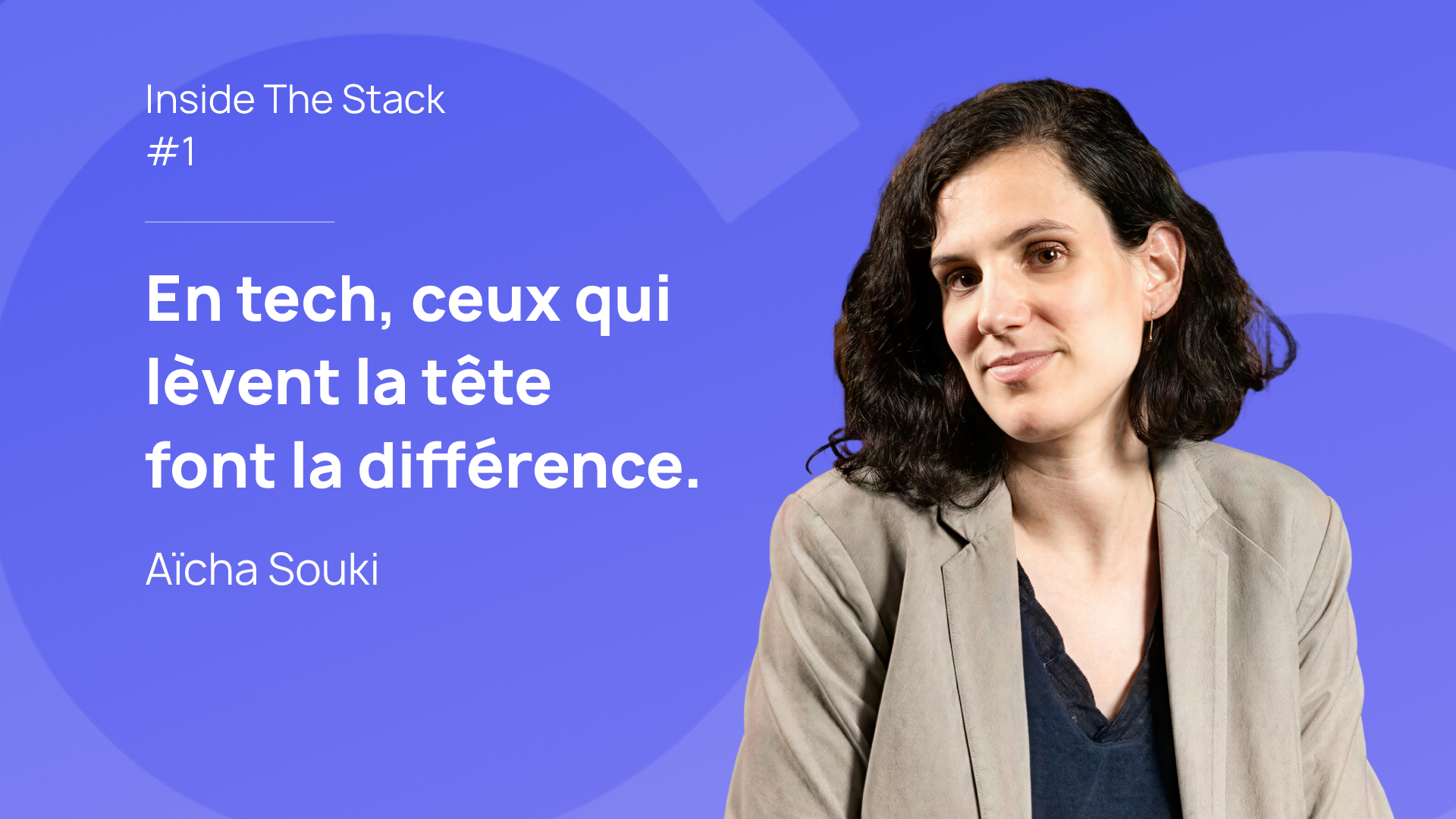
Within the data teams of major insurers, something has quietly shifted. It is no longer the best coders who make the difference, nor the most skilled modellers. It is those who look up. Those who return from the field with an idea to test the following morning. Those who do not wait to be assigned a task before taking the lead.
Aïcha Souki has been heading up the Data and Customer Approach Division at Generali France for the past two years, leading a team of around thirty people comprising actuaries and data engineers, working across all the group’s business lines. Before that, she spent five years at AXA, working in both group pension actuarial and individual life risk management. Before that: École Polytechnique, followed by École des Ponts. A pure engineer pedigree, which shifted towards AI before the term became fashionable, and who now views generative models and agents with the clarity of someone who has already weathered several waves of technological drifts.
I’m delighted to share our discussion with you. We talk about skills, organisation, and what ‘being performant’ means when tools change faster than job roles.
—
Aïcha, whilst preparing for our conversation, I came across a phrase you’d used in an interview: “You end up in insurance by chance, but you stay in it by choice.” It made me smile because we use it almost word for word at Continuity. How did you end up there?
In my case, it all came down to a recommendation from a good friend who was working at AXA Spain. At the time, I’d just finished my degree in applied mathematics at École Polytechnique and was more set on a career in industry. To give you an idea, I’d almost sworn myself never to join the financial sector, which seemed far too abstract to me. I was more drawn to companies like Air Liquide, EDF or GDF, with very significant operational challenges.
But this friend told me about AXA. He seemed convinced that I’d enjoy it there and that I should look into it. I followed his advice and had some initial discussions. I soon had to face the facts: he was right. Firstly, because I got to talk to some truly outstanding professionals, and also because of the practicality of it. Insurance is present in every corner of the real economy. It’s all-encompassing. Between motor and life insurance, you build an almost 360° view of people’s lives.
Did you have an epiphany or a specific moment when you realised it was the right fit for you?
It grew on me quickly and naturally. I instantly found it intellectually stimulating. Insurance lies at the crossroads of law, operations, statistical probability, technology, etc. It’s an extremely broad sector with great technical depth across all roles.
So I got into it straight away. Even working in inventory, not everyone’s dream job, I found it incredibly rich at every stage. I felt at the heart of the business and the company’s strategic development challenges.
That was 13 years ago. I’m still working in that space and I’m loving every bit of it.
You mentioned diversity. It’s true that insurance companies are a good environment for getting to grips with all sorts of roles. I saw that you even spent some time in partnerships, which has a more commercial focus. Did you enjoy it, and what did you take away from it?
That’s right, I spent nearly five years working in partnerships at Generali. It was an incredibly inspiring experience because I discovered a world completely at odds with my own.
When you’re trained in risk management, you spend decades rationalising, analysing and modelling everything. Then suddenly, you find yourself dealing with brokers who rely heavily on intuition. It was inspiring to see the importance of instinct, interpersonal skills and relationship-building when you’re on the front line with the client. And we’re talking here about people who have built businesses now valued at several hundred million euros.
It was a real eye-opener. It helped realise that value doesn’t always come from where you expect it to.
I came to insurance via technology, not the other way round. And I often get the impression that those who’ve taken the opposite path have a different take on the problems that need solving. Is that something you recognise in your own trajectory?
Absolutely. My technical acumen has had a major influence on my career path. For example, my first project in this role was to look at making better use of the DSN — the “Déclaration Sociale Nominative”.
Until 2017, we would only receive aggregated data when underwriting a group policy: a premium amount, a vague idea of the portfolio, but nothing detailed about the policyholders. The DSN changed everything. All of a sudden, we were able to gain an insight into each policyholder individually.
That’s just one example, but to answer your question: I constantly follow my engineering mindset, which I apply to insurance challenges. In this case, the engineer in me saw an opportunity to extract detailed insights about our customers from a vast amount of data.
From the outside, big corporations can sometimes seem a bit paralysed by their size and red tape. That’s not the impression I get when I hear you talk about Generali. Do you feel free to lead and take initiatives?
Absolutely, I think that’s actually one of the group’s strengths. When you spot an opportunity, you just need to raise your hand and take it on. You need to get 10 people’s sign off on it.
The company is very focused on third-party distributors, which allows us to pick up on market trends very quickly. As data experts at Generali, we’re also expected to be highly cross-functional. It’s up to us to seek out topics and make connections.
This proactivity isn’t a given. It’s a culture that needs to be instilled within the team, but the groundwork is in place.
As a technical specialist, you often face the risk of innovating in isolation, far from the reality on the ground. How do you tackle this issue?
We have a simple principle: everyone must spend one day a year on an immersion placement. This could be a day in the office of an underwriting or claims expert, or even at a branch.
It’s always incredibly energising; almost too much, in fact. (Laughs) The teams invariably come back with hundreds of ideas, which we then nuance and prioritise together.
But I like to see this second phase as part of the learning process. The pitfall, of course, is to draw general conclusions from an isolated case. So we spend a lot of time digging into the use cases that will bring value to as many people as possible.
The fact remains that it’s an extremely educational experience, both in terms of insurance and in terms of product development.
As a SaaS provider, I’m constantly faced with the issue of integration into already complex IT systems. But even before integration, there’s the question of the quality of the data generated upstream. How do you approach this at Generali?
Data governance is a subject I’d never had to deal with as recently as two years ago. I have to admit I didn’t see it as the most exciting topic at first. From the outside, it looks like a bottomless pit, swallowed up by somewhat cryptic linguo, like “Cataloguing”, “data lineage”, “data ownership”… enough to put most people off.
However, listening to talks by data governance experts have helped me get past this. I discovered that the matter could also be handled in a very simple, practical and even humane way. Behind these daunting concepts lie simple principles that everyone can relate to: sharing a common vocabulary, clearly describing the data, tracking its flows… Making it more accessible and adopting a value-led discourse has helped federate the team on the matter. We managed to set up an organisational structure that fosters autonomy, clarifies roles and aligns individual contributions with overall performance.
Very interesting! I’d now like to hear a bit more from you on a key topic in tech: talent management. The market is shaken up every two weeks by disruptive innovations. How does that affect your day-to-day work? For you? For your teams?
It’s true that it feels that every quarter is shaken by minor technological earthquakes. Handling them is no easy feat from a managerial standpoint.
From my point of view, one of the most significant changes is the shift in balance between technical skills and soft skills in technical roles.
Let me explain: until now, a developer’s value lay in their hard skills; their ability to master complex programming languages and bring ideas to life. The barrier to development has been virtually wiped out within the space of three years, on a global scale. As a result, value has rapidly shifted from production towards conceptualisation.
It feels like that the ‘team stars” are no longer the same. Today, those who make the difference are those who experiment quickly and constantly look up. Those who bring new ideas to the table. Those capable of combining technical excellence, creativity and discernment are the ones who thrive.
It’s slightly exaggerated obviously, but we’re moving from a world of hard skills, where code was king, to a world of soft skills, where curiosity and creativity are taking the lead.
Fascinating. How do you manage the tensions that stem from this shift? How do you help your more ‘technical’ team members adapt to this new world?
I’ll start by specifying that all this technical expertise, of course, hasn’t become obsolete overnight. It remains essential and always will be. We’ll always need experts to guide the work of A. Experts who can monitor it and refine it. That’s a given.
I consider the challenge to be more about building the right workflows in which to integrate all this technical expertise.
We’re thus trying to foster an ever-stronger culture of iteration and exploration.
In order to do that, I like to organise regular team challenges. We try to vary the rules and formats to spark new ideas; some will work without prompts, with prompts, using full code, no code, and so on. We all circle back at the end to share best practices.
Ultimately, my aim is to expose them to new ideas and fresh perspective.
That said, I firmly believe that innovation doesn’t always have to be grand or profound. An idea doesn’t need to be complex to be great.
There’s actually a quote from Picasso that I love, which I keep adding to my slides: “Bad artists copy, good artists steal.” And underneath, the Banksy version where he’s crossed out Picasso’s name and put his own in.
Brilliant! I completely agree with you on these new dynamics of production. Do you think this ‘post-technical-skills’ era will leave humanity worse off? Do we lose something when we lose skills?
That’s the real debate. My husband is an engineer, and he is all about fluid mechanics. (Laughs)
Whenever we talk about it, he draws a parallel with what’s happened with digital modelling in engineering. He reckons that by constantly delegating to machines, we’ve lost our intuition and the ability to do things ‘by hand’.
In that sense, I agree with him on one point: without understanding what’s going on in the works, we’re putting our destinies in the hands of machines. If we can no longer tell when it’s making a mistake, that’s the start of the downfall.
However, I also argue that we can’t reason in the same way with junior staff. Those entering the labour market today can’t ‘lose’ a skill they never developed under the old paradigm. They’re building their skills directly using the new tools.
This is, in fact, what we’ve seen at schools such as the Albert School. Students developed a contract simulator, cross-referenced Waze data with accident statistics, and delivered a working prototype in under a week. What I find fascinating about this is their completely uninhibited and unrestrained approach to experimentation. The new generation simply doesn’t see the same barriers that we do.
To conclude, I’d like to take a step back and look at the bigger picture. The market is in a state of upheaval. Everyone’s talking about AI. Some say little about what they do well, whilst others spin fabulous tales based on proof-of-concepts. Amidst all this noise, how do you chart a course? How do you prioritise?
It’s true 2026 starts feeling merciless. As if we could no longer afford to miss a turning point at this point.
However, I’m convinced that everyone has their own path to follow. It’s up to each business to take stock of their strengths and weaknesses.
Generali’s strength lies in being agile, tech-savvy and extremely closely connected to the business. Our thinking must therefore take all this into account and not rush headlong into a strategy that our competitors might adopt.
That’s what we did and we’ve already achieved some significant milestones. I’m thinking, for example, of AI coding or the use of AI to structure raw data. These new ways of working have really become part of our day-to-day practices.
This has enabled us to transform the way we analyse expert reports and emails for example. It’s not always glamorous, but it makes a real difference to our teams’ day-to-day work.
Our next point of focus is about harnessing agentic technology. This is the real turning point we must not miss, across the entire chain, in both sales methods and internal efficiency. We have laid the groundwork to deliver value, but we’re still operating within a decision-support framework. The next step we need to deliver is autonomy.
These are, of course, long-term projects, but Generali has very clearly committed to giving all teams access to AI. Just as with the governance we were discussing, access to these tools cannot be reserved to technical teams. This is important for our innovation culture, but also for our security. If employees have to go outside our systems to iterate, that’s when we lose control of our data.
Thank you, Aïcha, for such an insightful discussion. I’d like to finish with one final question: if a young woman fresh out of university asked you whether insurance is a good sector in which to build an ambitious career in tech, what would you say?
I’d tell her that insurance isn’t just about grey suits. (Laughs) I’d tell her that she’ll find extraordinary technical depth there; mathematical, technical, regulatory and legal. She’ll be entering a whole new world with every new role.
I’d also finish by adding that it’s a sector that’s constantly evolving. There are always new directions to take, always areas where someone can step up and make a difference.
Aïcha Souki is Head of Data and Customer Experience at Generali France. A graduate of École Polytechnique and École des Ponts et Chaussées, she has spent thirteen years in the insurance industry with AXA and Generali, working at the intersection of actuarial science, risk management, partnerships and data.
Inside The Stack is a series of interviews hosted by Pierre, CTO of Continuity, featuring tech professionals in the insurance sector. The next episode is coming soon.
